
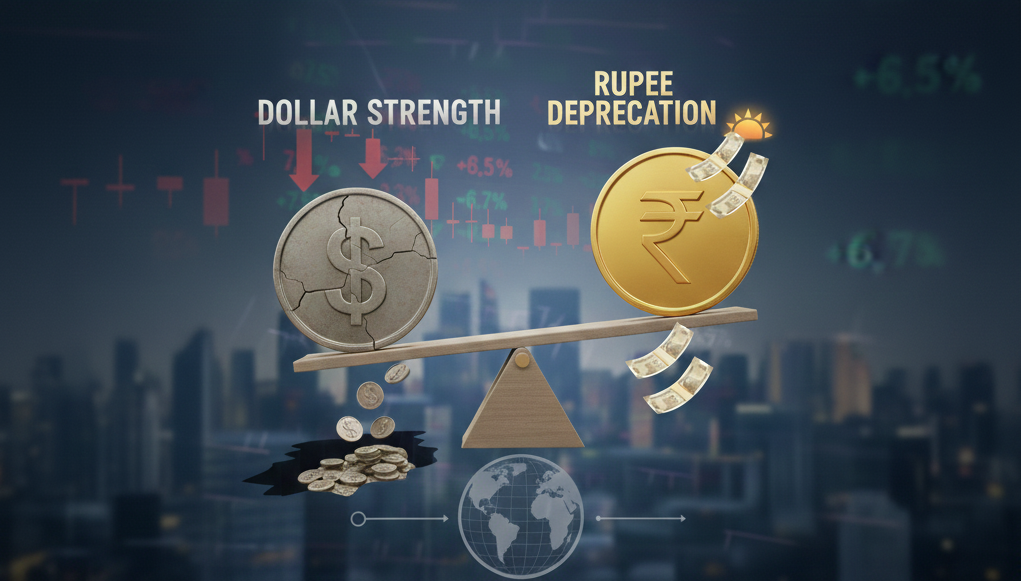
A depreciating rupee fundamentally improves export economics. Most exports are invoiced in USD, while production, labor, and overheads remain Rupee-denominated. As the rupee weakens, the same dollar revenue converts into higher INR earnings, expanding margins even without an increase in volumes.
And the opportunity goes beyond exchange rate mathematics. India is now more attractive to global importers than at any time in the past decade. Why?
- Geopolitical shifts and tariffs are forcing global companies to diversify supply chains away from China to reduce risk (China + 1 Strategy). India’s large labor force, improving infrastructure, and business-friendly reforms have made it a favored alternative
- Major multinational manufacturers are expanding operations in India to serve global markets. Apple, for instance, has sharply ramped up iPhone assembly in the country, with exports crossing $10 billion in H1 FY2026, up 75 per cent year-on-year, a clear signal of India’s deeper integration into global electronics supply chains
- India’s expanding network of free trade agreements and rising export competitiveness further enhance its appeal as a sourcing hub
These trends create urgent strategic imperatives for Indian exporters: global buyers are willing to shift volumes, but only if suppliers have the capacity, liquidity, and delivery guarantees to fulfil larger contracts. Importantly, this depreciation is not a short-term anomaly.
What does this mean for CFOs?
For CFOs, this creates a more predictable USD–INR FX rate environment for pricing, contracting, and hedging decisions. With prices of goods and logistics costs relatively stable, the FX upside from Rupee weakening is not being fully offset by higher input costs, making this an unusually favorable phase for export expansion. This is your time to scale exports, lock in long-term buyer relationships, and expand market share. But opportunity alone does not convert into growth, unless it is backed by liquidity.
Let us look at a real case study (name anonymized for privacy)
When the Indian rupee began weakening against the US dollar, one of our exporter clients saw more than just a currency move- they saw an opportunity.
Peacock Engineering Pvt. Ltd., an Indian exporter of industrial valves, supplying to overseas buyers and invoicing in USD, was witnessing steady demand. With USD invoices translating into higher INR realizations, the company was keen to take larger and more frequent orders. The challenge, however, was working capital. Longer payment cycles meant cash was tied up in receivables, limiting the exporter’s ability to scale production and confidently accept incremental orders.
That’s where VTX stepped in.
By unlocking liquidity from its USD receivables through its product offerings, VTX helped Peacock Engineering strengthen its working capital position almost immediately. Early access to funds enabled it to ramp up production, service increased order volumes, and offer greater comfort to their overseas buyers without waiting for the usual 90–120 day payment cycles.
This timely liquidity proved critical as the weaker rupee amplified the value of every dollar earned. With faster realizations, the exporter was able to convert USD invoices into higher INR sooner, fully capturing the currency tailwind rather than seeing it eroded by delayed cash flows.
Factoring as a Strategic CFO Tool
Executed on open-account terms Factoring, or receivables discounting, allows exporters to convert receivables into immediate cash once goods are shipped and the invoice is raised.
- Liquidity without leverage: Factoring does not add debt to the balance sheet and improves financial ratios
- Faster monetization of FX gains: Early receipt of USD-linked cash flows improves control over conversion timing. No hedging required
- Support for export scale-up: Transaction-linked funding expands in line with sales, unlike rigid bank limits
- Risk mitigation: Combined withcredit insurance, factoring protects against buyer default and geopolitical disruptions
How VTX enables export growth
VTX enables exporters
- to convert receivables into immediate cash through post-shipment factoring.
- to scale limits dynamically with export volumes to enable CFOs access to ad-hoc liquidity to support spikes in demand, without straining working capital or adding debt to the balance sheet.
- to connect to a large and diverse pool of global financiers, ensuring coverage of a wide range of products, currencies, and geographies.
- to get the lowest available interest rates with a transparent bidding mechanism.
The CFO Takeaway
For CFOs, the decision to pursue export growth is largely settled; the critical consideration now is the pace and confidence with which it can be pursued. With the right use of factoring on the Vayana TradeXchange platform, exporters can now increase shipments, offer longer credit terms, protect cash flows, and capture FX gains, turning the current USD-INR volatility into a sustained export advantage.